Home / Products
Products
We supply laminated neoprene fabric — not finished goods. The neoprene core is bonded to a knit backing and delivered as roll, cut length or slit tape, in the thickness and hand-feel your product needs. The plant runs thirty-six laminate specifications in regular production; the seven groups on this page are how they break down. Anything outside that range is quoted per order.
01 — Core material
SBR Laminates
SBR is the workhorse of the range and the widest price band. It takes a bonded knit face cleanly, holds thickness well through splitting, and is the sensible choice for anything that is not going into continuous water or oil contact.
Stock gauges
2.0 mm, 2.5 mm, 3.0 mm and 4.0 mm are the stock gauges. Other gauges are produced to order — the core is split down to the figure on the drawing rather than ordered in from outside.
Typical pairings
Polyester knit, two-way stretch Meijia (T-cloth), OK cloth and Lycra. Single-faced for a fabric back, or double-faced when both sides are seen or the panel has to resist curling.
Where it ends up
Support and brace panels, protective sleeves, cushioning pads, bottle and cup sleeves, ball covers, goggle straps and general cushioning where the budget is the deciding factor.
Polychloroprene, and the top of the range. It resists oil, ozone and weather in a way SBR does not, keeps its flexibility across a wider temperature range, and is what you specify when the part has to survive years of exposure rather than one season.
Stock gauges
2.0 mm, 2.5 mm, 3.0 mm and 4.0 mm — the same gauge band as the SBR range. Heavier or intermediate thicknesses are split to order rather than held in stock.
Smooth skin finish
One face left unbacked and sealed, giving a low-friction, water-shedding surface. Used for waterproof covers, matting and any panel that has to keep water on the outside.
Bonded to high-stretch knit
CR also runs bonded to super-stretch backing for medical and protective covers, where the panel has to stretch over a shape and still hold its shape afterwards.
Cost expectation
Roughly 3–4× the SBR band for the same thickness. Quoted per order.
02 — Core material
CR (Chloroprene)
03 — Core material
SCR High-Stretch
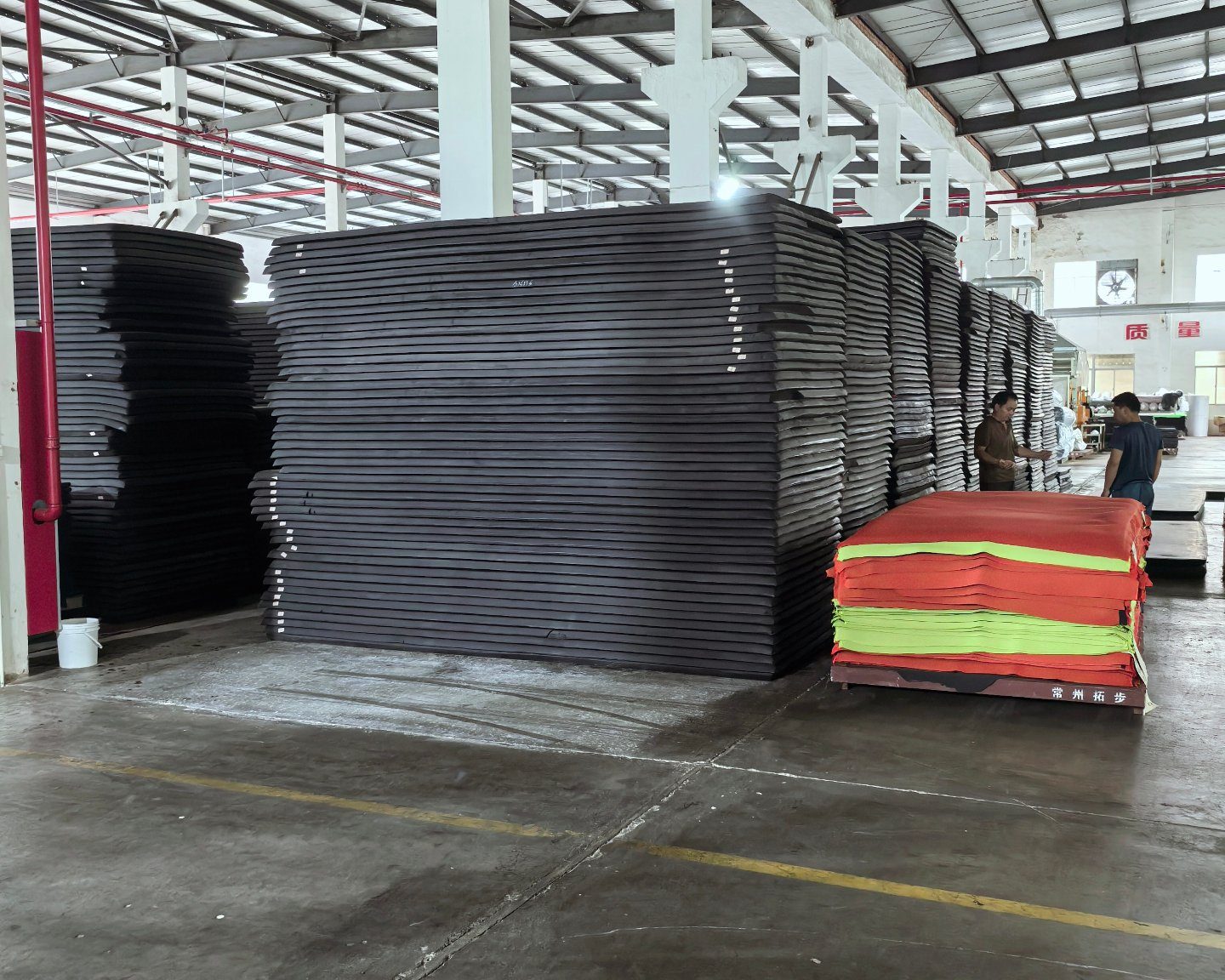
The stretch grade. SCR sits between SBR and CR on cost and behaves differently from either — it recovers rather than sags, which is what makes it the grade for anything worn against the body or pulled over a limb.
Stock gauges
2.0 mm, 2.5 mm, 3.0 mm and 4.0 mm — the same gauge band as the SBR range. Heavier or intermediate thicknesses are split to order rather than held in stock.
Breathable builds
Punched or perforated SCR lets air and water out without losing the closed-cell core, which is how breathable wetsuit and rash-guard panels are made.
Bonded to OK cloth
The usual pairing. OK cloth gives the laminate a soft, non-abrasive face over the stretch core, so it can be worn directly on skin.
Where it ends up
Dive and surf apparel, knee and elbow supports, compression panels, anything that has to move with the wearer and return to shape.
EVA is the light alternative to the neoprene cores — a closed-cell foam specified where the finished part has to shed weight without losing a soft, resilient face. It is bonded and finished at the partner plant we manage, on the same backing range as the chloroprene grades.
Stock gauges
EVA is quoted against your drawing rather than from a fixed stock list. Send the panel thickness and the build, and the available range comes back with the quotation.
Light by nature
A low-density closed-cell foam. Where a panel is judged on weight rather than on oil or weather resistance, EVA does the same job as a neoprene core at a lower mass.
Where it ends up
Footwear midsoles and inserts, bag and case padding, protective packaging and moulded sports goods — anything that wants a light closed-cell core under a knit face.
04 — Core material
EVA Foam
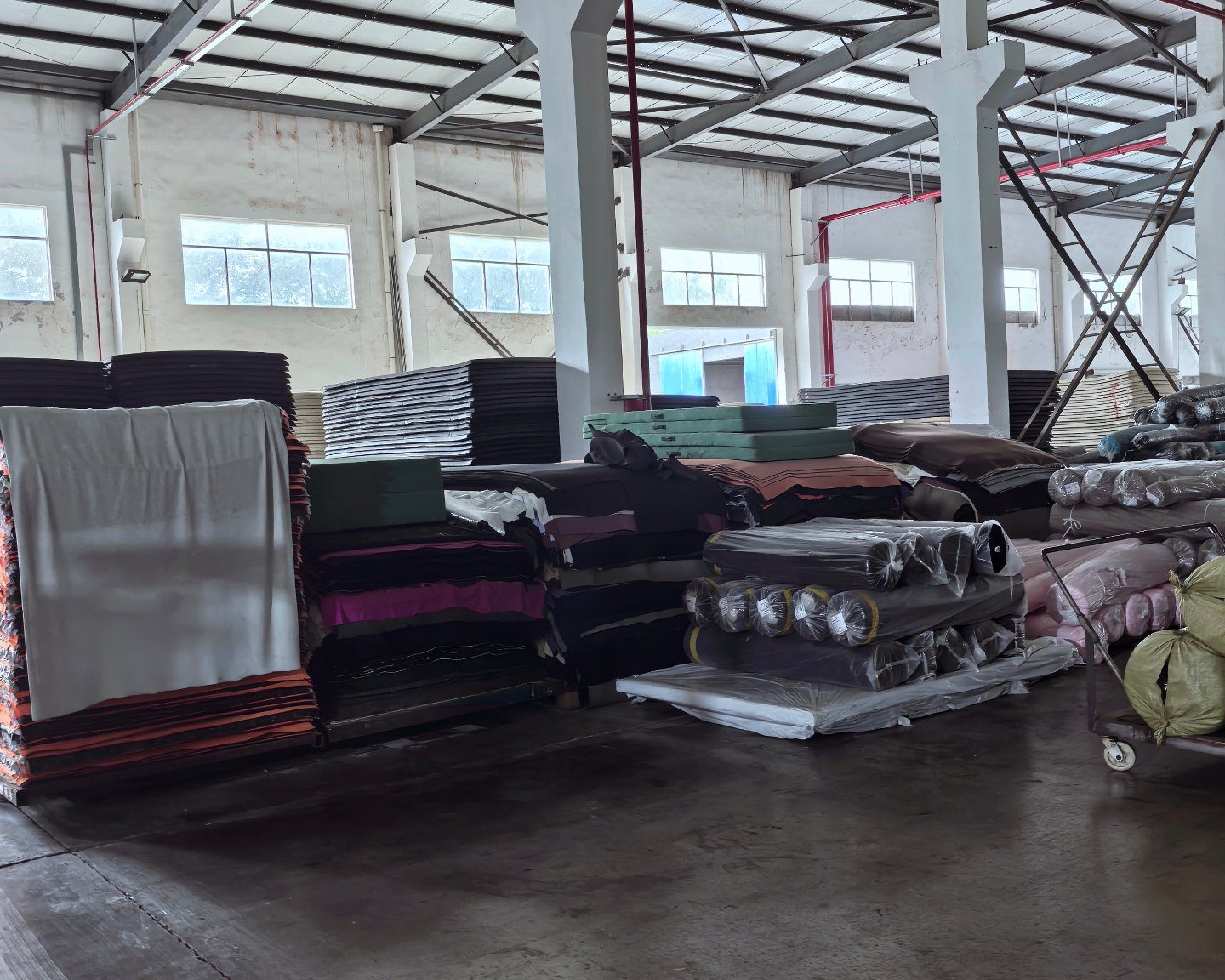
The backing decides how the laminate feels, how far it stretches and which way it stretches. Most specification arguments are really backing arguments, so it is worth settling this before the core.
Two-way versus four-way
T-cloth (two-way stretch Meijia) gives with the width only, which keeps the panel stable in length — better for belts and straps. N-cloth (four-way stretch Meijia) gives in both directions and is the one for anything that has to conform to a curved body.
Lycra and visa cloth
Lycra for maximum recovery and a smooth print surface; visa cloth where the face has to stay light and dry quickly. Both are bonded, not coated, so the hand-feel survives washing.
OK cloth and polyester knit
OK cloth for a soft skin-facing surface over a stretch core; polyester knit as the general-purpose, print-receptive face at the lowest cost.
05 — The face
Backing Fabrics
06 — How it is bonded
Bonding Methods
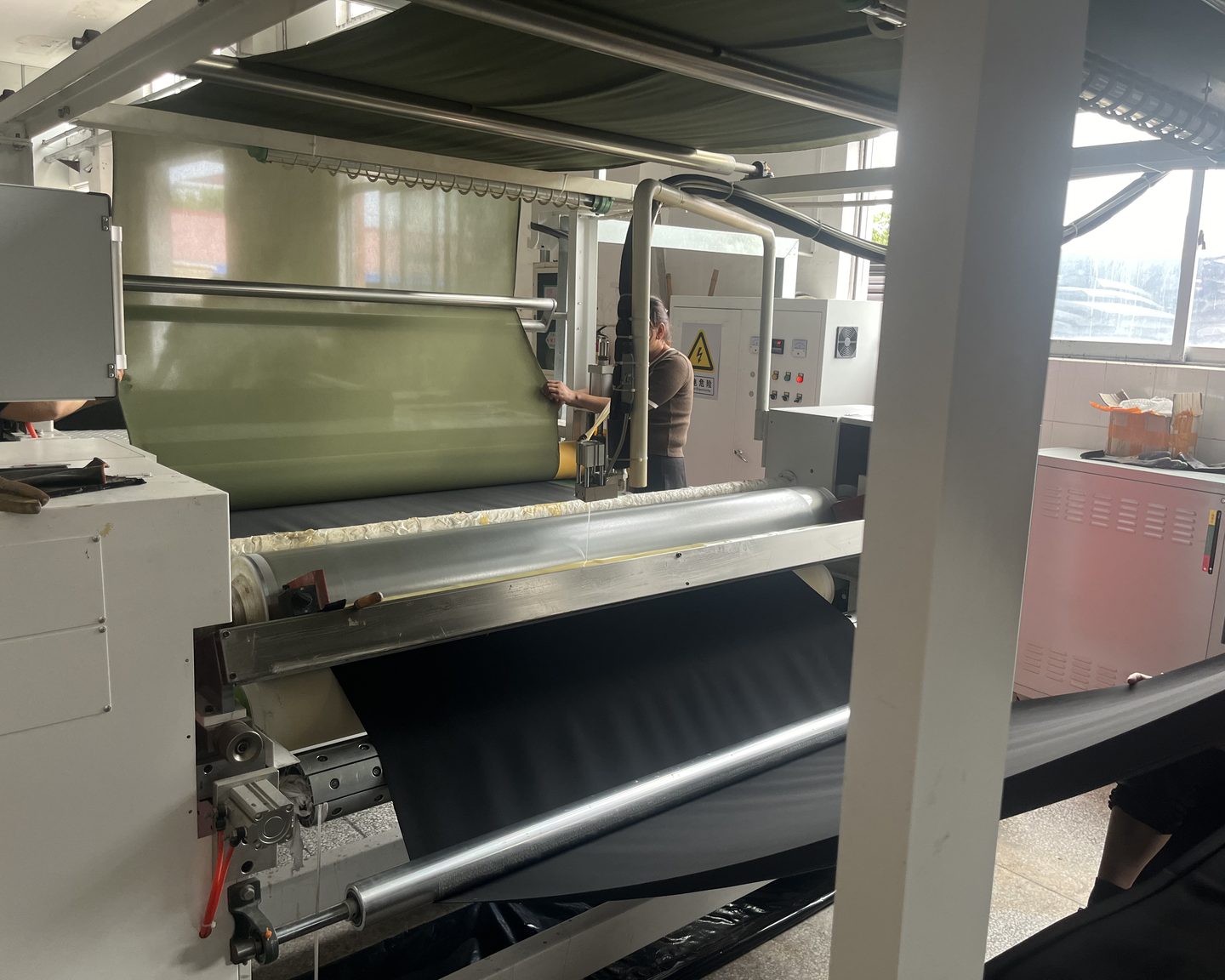
Bond strength is the failure point in most neoprene laminates, so it is the part of the process we are least willing to compromise on. If a customer has had a laminate delaminate in the field, this is where the fix usually is.
Odour-free bonding
Bonding runs odour-free, without the solvent smell that normally hangs around neoprene laminate. It matters for anything worn on the body, kept in a bag, or shipped in a sealed carton.
Bond stronger than the backing
The test we work to is blunt: pull the laminate apart and the knit should tear before the bond lets go. If the layers separate cleanly, the bond is wrong regardless of what the number on the datasheet says.
Three routes
PUR odour-free bonding, oil-based compound and water-based compound. Which one you get depends on the backing, the core and what the finished part has to survive — not on which line is free.
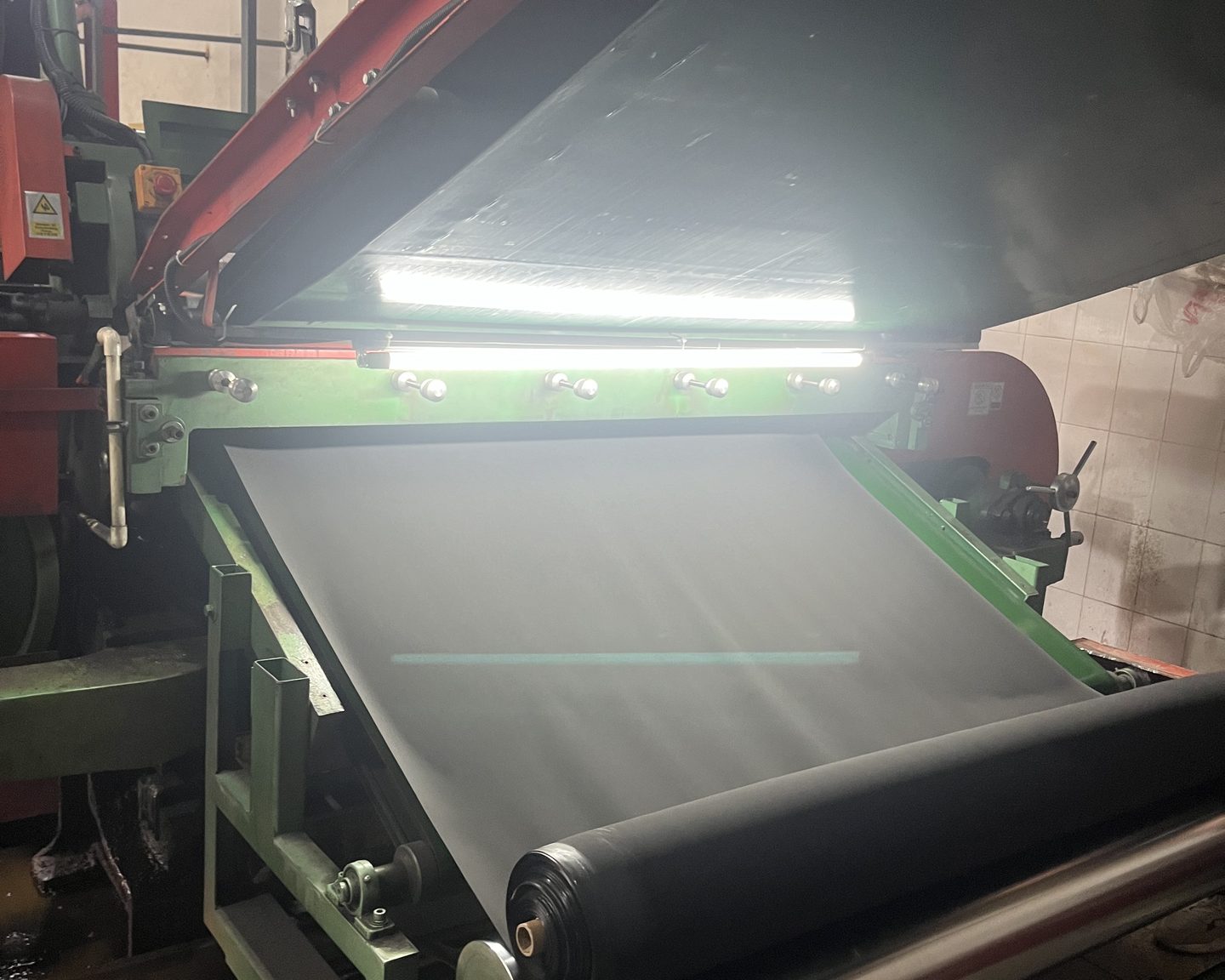
Finishing is what turns a roll of laminate into something your cutting room can actually use. It all runs at the partner plant, so a change of thickness or surface does not mean a week lost to an outside subcontractor.
Splitting
Automatic high-precision splitting brings the core down to the exact gauge rather than the nearest stock size, and evens out thickness across the roll. Tolerance holds across the full width.
Surface work
Punching and perforating for breathability, embossing for a raised or grained pattern, brushing for a suede-like hand. On CR this is also where the smooth-skin face is finished.
Supply form
Roll, cut length or slit tape to your width. Tell us how your cutting room wants to receive it and we will supply it that way rather than making you re-handle it at your end.
07 — Last step
Splitting & Finishing
Material reference
The four cores, side by side.
These are the four grades we supply as standard. If your specification calls for something outside them, send it anyway — the answer is usually a sourcing question rather than a no.
| Core | Thickness | Behaves best when | Cost band |
|---|---|---|---|
| SBR | 2.0–4.0 mm | General cushioning and support panels; dry conditions, budget-led programmes | $ |
| SCR | 2.0–4.0 mm | Stretch and recovery; body-worn panels, breathable builds | $$ |
| CR (chloroprene) | 2.0–4.0 mm | Oil, ozone and weather exposure; wide temperature range; smooth-skin faces | $$$$ |
| EVA | Quoted per order | Light closed-cell builds; footwear, padding and packaging where weight is the driver | $ |
| Backing | Stretch | Chosen for |
|---|---|---|
| T-cloth — two-way stretch Meijia | Width only | Panels that must stay stable in length — belts, straps, load-bearing parts |
| N-cloth — four-way stretch Meijia | Both directions | Conforming to curved shapes, body-worn products, maximum freedom of movement |
| Lycra | Four-way, high recovery | Compression fit, smooth surface, best print result |
| OK cloth | Moderate | Soft skin-facing surface over a stretch core |
| Polyester knit | Low | General purpose, lowest cost, print receptive |
| Visa cloth | Low | Light, fast-drying faces |
Cost bands are indicative only and are shown to help you compare cores during design. Actual pricing depends on thickness, backing, bonding method and order quantity, and is always quoted per project. Gauge availability is confirmed per order — the band above is the range in regular production, and a figure outside it is a question to ask rather than an automatic no.
Next step
Tell us the part, we will tell you the laminate.
Describe what the fabric has to survive and how it will be cut. We will come back with a core, a backing, a bonding route and a piece price.